Balance Sheet
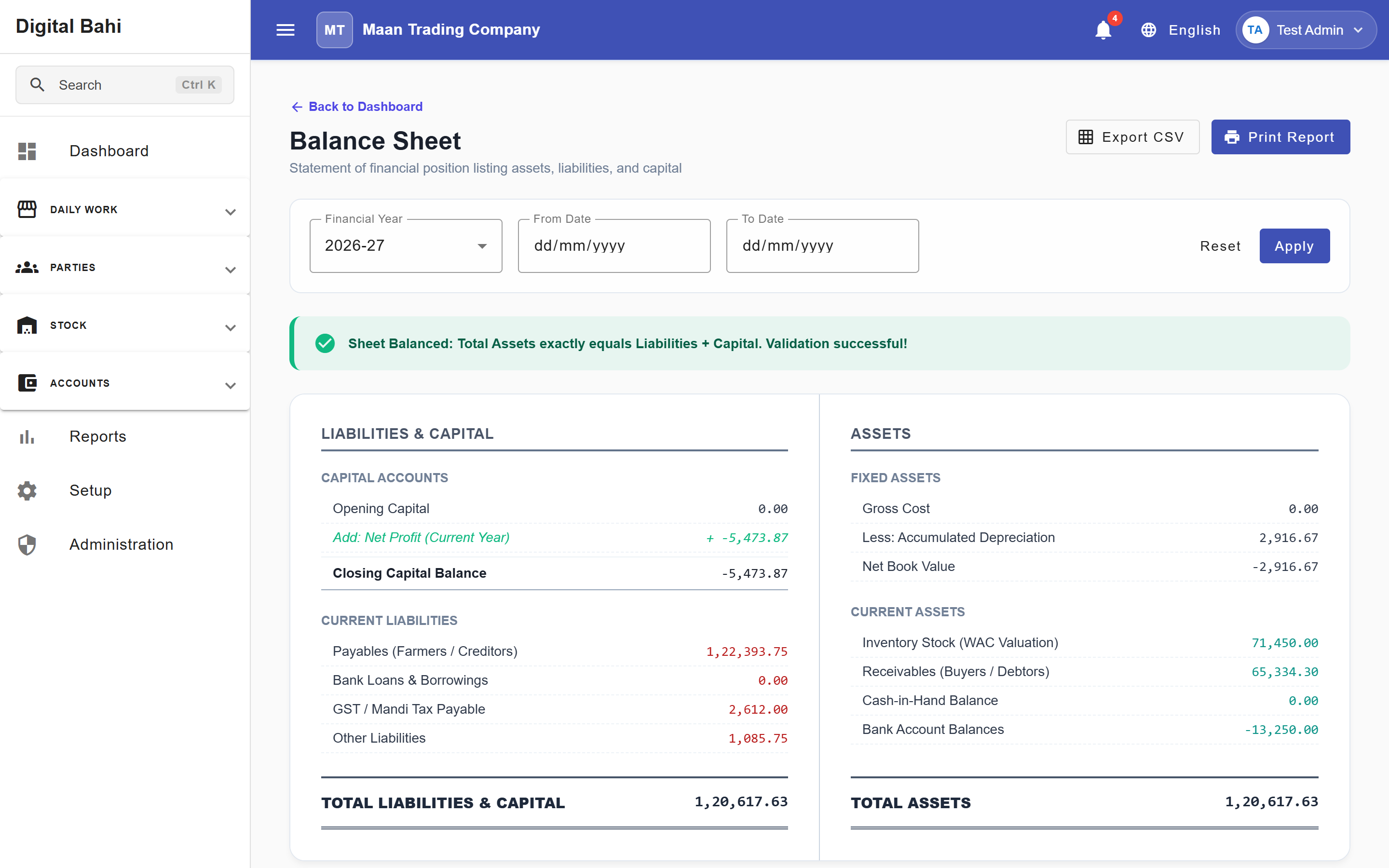
The Balance Sheet (Reports > Financial Statements > Balance Sheet, /accounts/balance-sheet) provides a snapshot of your business's overall financial position on a specific date.
What is this?
The Balance Sheet summarizes what your business owns (Assets) and what your business owes (Liabilities & Capital), verifying the fundamental accounting equation (Total Assets = Liabilities + Capital).
When should I use it?
Accountants and business owners generate the Balance Sheet at the end of a month, quarter, or financial year for tax, audit, and bank financing purposes.
How to use it
- Open Reports (
/reports) and select Balance Sheet under Financial Statements (/accounts/balance-sheet). - Select the Financial Year or As Of Date and click Apply Filters.
- Review the top validation banner (Sheet Balanced) and the three KPI cards (Total Assets, Total Liabilities, and Closing Capital).
- Inspect the Liabilities & Capital column on the left and the Assets column on the right.
- Click Export CSV or Print to download or print the statement.
Sections explained
Liabilities & Capital
Represents the sources of your business's funds and obligations owed to others:
- Capital Accounts: Shows Opening Capital, adds Current Period Net Profit (from the Profit & Loss statement), and computes Closing Capital.
- Current Liabilities:
- Farmer & Supplier Payables: Net payable balances owed to Farmers and Suppliers.
- Loans & Borrowings: Outstanding business loans.
- Tax / GST Payable: Net tax liabilities owed to the government.
- Other Liabilities: System charge liabilities such as Dhanka (
SYS-LIAB-DHANKA) and Tulai (SYS-LIAB-TULAI).
Assets
Represents the resources owned by your business:
- Fixed Assets: Displays Gross Cost, Less: Accumulated Depreciation, and Net Book Value.
- Current Assets:
- Inventory Stock (Closing): Financial value of your current physical godown inventory.
- Buyer Receivables: Net amounts owed to your business by Buyers/Parties.
- Cash in Hand: Closing physical cash balance.
- Bank Account Balances: Net book balances across your business bank accounts.
- Other Assets: Advances or miscellaneous current assets.